
SpaceX IPO: The First Week — A $225 High, a Pullback, and What Nobody's Talking About
Last week, we published three deep dives into SpaceX's S-1:
• SpaceX IPO — A line-by-line reading of the entire filing. The numbers, the three business segments, the Anthropic contract, the Cursor option, and the governance reality.
• Correcting the Record — The "Conglomerate Discount" Explained — Where we corrected our own mistakes, recalculated the Starlink valuation, and explained why the S-1 numbers don't tell the whole story.
• What the S-1 Doesn't Tell You: The Bundling Problem at $1.75T — Where we made our core thesis: investors can't cherry-pick Starlink. They must buy the entire package — Starlink, launch, xAI, Mars, governance risk — all at once.
We concluded that at $1.75T, the market was pricing in extraordinary optionality for extraordinary risk. The question was: would the market agree? It did. And then it went even further than we imagined — before cooling its heels.
The First Week: A Price Timeline
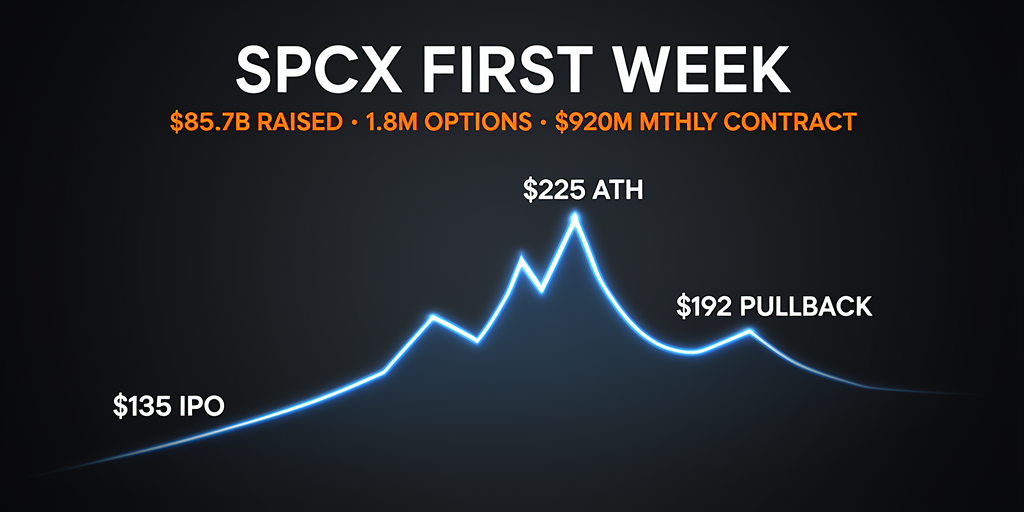
SpaceX priced its IPO at $135 per share, issuing 555,555,555 Class A shares and raising $75 billion — the largest IPO in history. The Green Shoe (underwriter over-allotment) was exercised on June 15, adding 83,333,333 shares and bringing total proceeds to $85.7 billion. Here is what the first four sessions looked like:
| Day | Open | Close | Change | Notes |
|---|---|---|---|---|
| Fri, Jun 12 | $150.00 | $160.95 | +19.2% | Record debut. Intraday high: $176.52 (+31%) |
| Mon, Jun 15 | ~$165 | $192.50 | +19.6% | First full trading day. ~$2.5T market cap |
| Tue, Jun 16 | ~$193 | $201.80 | +4.8% | Options debut. Intraday ATH: $225.64 (+67.1%) |
| Wed, Jun 17 | ~$203 | $191.82 | -5.0% | First red day. Stock clears $210 then reverses |
By the close of Tuesday, June 16, the stock had gained 49% from the IPO price, at one point touching $225.64 — roughly $3.0 trillion at the peak, about $850 billion above the IPO-day close valuation. Depending on which base figure you use (reports range from ~$690B to ~$866B for Musk's stake at the IPO price), his holdings were worth roughly $1.0–1.5 trillion at the intraday peak. This is not a stock that rejected its IPO price. It bid itself significantly above it in three trading sessions, then gave back a portion of those gains on its first pullback. The first red day was still within 42% of the offer price.
What Changed Since Our Original Analysis
The Google Contract: xAI Revenue That Isn't Hype
On June 5, SpaceX filed a regulatory disclosure revealing a $920 million per month compute rental agreement with Google. Google will lease approximately 110,000 NVIDIA GPUs, plus CPUs, memory, and related infrastructure, from SpaceX's xAI Colossus data center in Memphis. The contract runs from October 2026 through June 2029. If billed at the full monthly rate for that full period, the headline value would be about $30.4 billion; reported terms also include ramp-up and termination provisions, so the realized value could be lower. Crucially, Google can reduce its commitment or terminate if SpaceX fails to deliver the contracted capacity. This is not an AI revenue projection — this is a signed, filed contract with real money. It changes the math on xAI from "burning cash at scale" to "contracted for tens of billions of dollars of future compute revenue, subject to delivery." How much of those $920M/month payments become gross profit depends on utilization, power, hardware depreciation, financing costs, and accounting treatment. Still, it is the first concrete data point validating the xAI compute infrastructure thesis at a scale that rivals major neocloud providers.
Options Trading: Record Volume, Extreme Sentiment
Options trading began Tuesday, June 16, and broke first-day volume records for any single stock, with approximately 1.8 million contracts traded, according to Cboe data cited by multiple outlets. Call volume significantly outstripped puts. Implied volatility opened near or above 100%, though former market makers caution that initial IV prints reflect dealer hedging costs, not directional forecasts. The options market is telling us something important: investors are chasing momentum in both directions. The record call volume is bullish, but the sheer size of the options book also means that any move — up or down — will trigger significant dealer hedging flows. This is not a stock you want to trade with leverage right now.
The Analyst Consensus Hasn't Moved
Early analyst coverage has clustered near the current price. FactSet data cited by Barron's put the average target across four analysts at about $189, while Oppenheimer's published target was $190. The average analyst view, at least among the first firms willing to publish, is that SpaceX, as it currently exists on paper, is worth roughly what it was trading at after the first pullback. The market hasn't moved far from consensus. Consensus hasn't moved far from the stock.
Green Shoe: Exercised. The Money Is In.
SpaceX's underwriters exercised the full over-allotment option on June 15, as is standard when the stock rises post-IPO — and the stock did more than rise, it rocketed. The exercise added 83.3M shares and ~$10.7 billion to the total raise, bringing the combined total to $85.7 billion. Musk re-shared a photo of traders wearing green shoes on the floor to X. Crucially: the company has raised $85.7 billion in gross IPO proceeds. That capital is in the company. The stock price from here does not directly affect SpaceX's ability to build, hire, or execute. It mainly affects secondary market participants, employee wealth, collateral value, and future financing optionality.
What Nobody's Talking About: The Index Trade Friction
Several passive index inclusions loom. CRSP and S&P Dow Jones benchmarks may move first, while LSEG's Russell indexes and MSCI are expected to add SpaceX around their late-June review cycle, with June 29 cited as an effective date by Investopedia. Together, these can force mechanical buying by index funds — no regard for valuation, fundamentals, or momentum. Just weight-by-weight accumulation. But the index trade is not as simple as "inclusion equals instant buying." Some of the demand can be front-run by hedge funds and market makers, and index providers differ on timing, public announcements, and implementation. The clean version is this: the dates are real enough to matter, but the execution mechanics are murkier than the simple narrative suggests. What this means for investors: The mechanical buying will happen, but the timing and size may differ from what the market is currently pricing in.
The Pullback Is Normal. The Rally Wasn't.
Every post-IPO stock gets its initial pop, its momentum days, and its first pullback. SPCX's first pullback happened on day four — normal timing. The stock closed at $191.82 on Wednesday, down 5%. The $225.64 ATH had been trimmed by roughly 15% by Wednesday's close. What matters is not the pullback itself — it is what it reveals. At $225, the stock's ~$3.0T cap valued the Google contract at roughly 100x its full headline value, or roughly 270x its annualized run rate. At $192, those multiples sit around 83x and 230x, respectively. Both numbers are aggressive — the market is not just buying the contract; it's buying the expectation that SpaceX can replicate this deal with multiple anchor tenants. The pullback is the market taking its first realistic look at the gap between a roughly $30B signed contract and a roughly $2.5T-$3.0T valuation. Our pre-IPO analysis remains structurally correct:
• Starlink is the only visible profit center ($11.4B revenue, 63% EBITDA margins)
• xAI is the optionality bet (now with a Google anchor contract worth tens of billions of dollars if delivered)
• The bundling problem is unsolved
• Governance risk is extreme
• Capex ($20.7B in 2025) exceeds total revenue
• At Wednesday's $192 close, the stock traded at ~135x price-to-sales and ~380x price-to-EBITDA
The Wednesday closing price ($192 vs. $161 on Friday) changes nothing about the company's IPO proceeds. SpaceX has raised $85.7B in gross proceeds. The S-1 already told us the fundamentals. The market is pricing a binary outcome — xAI wins or it doesn't — and the pullback is the market's first breath after sprinting up a flight of stairs.
What Comes Next
June 22–23: Can the $190 Support Hold?
Monday and Tuesday are the real test after the Juneteenth market holiday. The first pullback in any post-IPO stock can trigger leveraged unwind, and with 1.8M options contracts on the board, dealer hedging can amplify moves in either direction. If $190 holds, the momentum thesis is intact. If it breaks, the stock could test $175–180, closer to the IPO-day close where our original analysis was anchored.
June 26/29: Russell Index Implementation
This is the next real catalyst. Index funds that track affected benchmarks will mechanically accumulate SPCX. The critique adds uncertainty about execution, but inclusion-driven demand is the question — especially timing and weight.
June 29: MSCI Inclusion
Expected around the same late-June window. Between Russell, MSCI, CRSP, S&P Dow Jones, and other benchmark providers, we are looking at mechanical, index-driven buying pressure that does not care about P/S multiples, governance risk, or whether Google terminates the compute contract. This is algorithmic capital, but the price impact depends on how much of the flow has already been anticipated.
The Real Test: Quarterly Earnings
SpaceX will report its first public quarterly earnings sometime in August. That is when the Google contract, the Starlink revenue run-rate, and xAI burn rate all get scrutinized under public market standards. That is where the optionality thesis either holds or fractures.
Our Position Going Forward
We stand by the fundamentals. The S-1 is the S-1. The Google contract is a real data point that changes the xAI narrative from pure burn to partially pre-paid infrastructure. But a contract is not earnings, and a compute lease is not profitability. The stock at Wednesday's $192 close is not a buy signal. It is not a sell signal. It is a sentiment indicator — a real-time poll of how much the public market believes in the xAI compute empire thesis. The pullback from $225.64 to $191.82 is the market taking its first realistic look at the numbers. The bundling problem remains. Investors cannot buy Starlink without buying governance risk, Mars speculation, and xAI execution risk. The market has decided that risk is priced in. Whether it remains priced in through the next earnings cycle is the story. We will continue monitoring and writing. The S-1 was the beginning. The public markets are where the story gets real.