
SpaceX at $150: What the Nasdaq-100 Won't Tell You About What It's Actually Worth
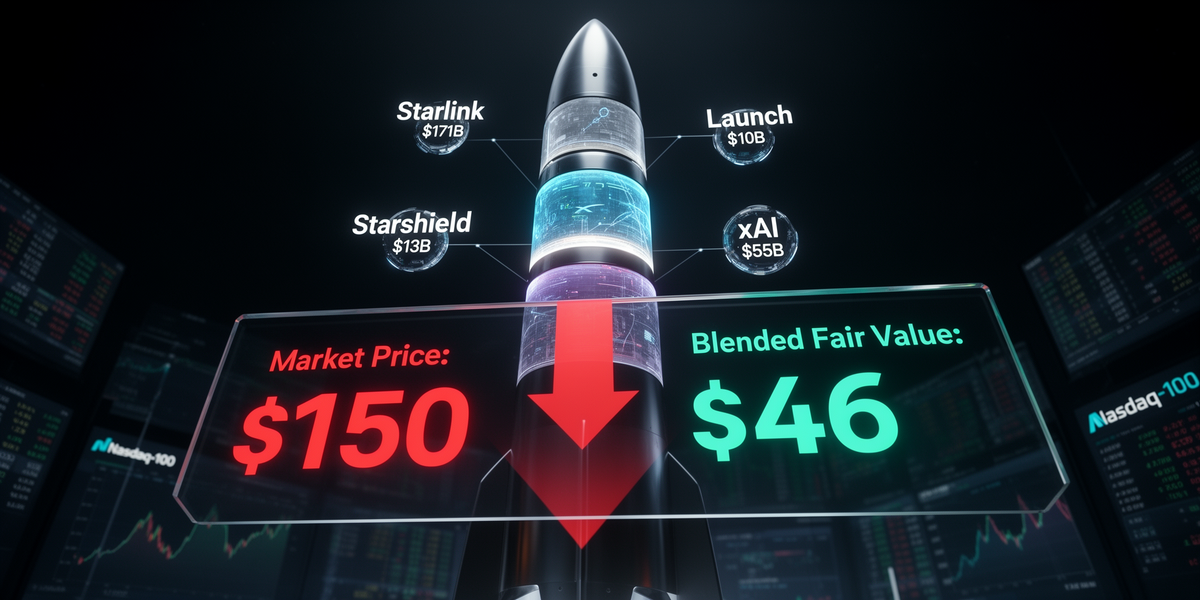
On July 7, SpaceX became the fastest company ever admitted to the Nasdaq-100. Less than a month after its June 12 IPO — only 18 trading days post-debut — passive funds benchmarked to the index were forced to buy the stock regardless of price. Nasdaq had changed its rules to fast-track the inclusion. By any conventional logic, this should have been a catalyst. Billions in price-insensitive demand meeting a float of barely 5%.
The stock fell. Two days after inclusion, SPCX closed at $148 — down 34% from its June 16 intraday peak of $225.64, and barely 10% above its $135 IPO offer price. The explanation is not mysterious: index-tracking funds needed to buy, but they were buying into a float where existing holders — many of them IPO flippers and momentum traders — were eager to sell. The forced buying was met with equally forced selling from the Green Shoe overhang (83.3M shares from the exercised over-allotment) and from investors who had been waiting for the liquidity event that index inclusion provided. When the marginal seller outweighs the forced buyer, the stock goes down — regardless of how many ETFs are compelled to hold it.
We have written about SpaceX twice before. In our pre-IPO analysis, we identified the "bundling problem": you cannot buy Starlink without buying rockets, and you cannot buy rockets without buying an AI company burning $6 billion a year. In our post-IPO correction update, we tracked the stock from its $225.64 peak to $155, asked whether the $190 support level would hold (it didn't), and noted that the analyst consensus (~$156 across six analysts) had been "directionally vindicated" — the market spent five days ignoring the sell-side and then round-tripped back to where analysts said it would be.
The stock is now at approximately $150. The analysts are divided by a factor of 13x — from Morningstar's $63 to Raymond James's $800. Morgan Stanley just initiated at $300. Passive funds are buying. The stock keeps falling.
It is time to stop tracking the price action and answer the only question that matters: what is SpaceX actually worth?
Methodology: Sum-of-the-Parts DCF
SpaceX is not a company. It is four businesses fused together by Elon Musk's deal-making, each with radically different economics, growth trajectories, and risk profiles. Valuing them as a single entity at a single multiple produces unreliable results — which is why most IPO coverage produced unreliable results.
We use a sum-of-the-parts (SOTP) discounted cash flow model, valuing each segment independently with segment-appropriate discount rates, growth assumptions, and margin structures. We then cross-check the DCF output with a market approach using peer-derived multiples. Finally, we run a reverse DCF to determine what growth rate the current market price implies — and test that growth rate against the physical constraints of the markets SpaceX operates in.
The four operating segments:
| Segment | FY2025 Revenue | YoY Growth | Operating Income | Margin | Business |
|---|---|---|---|---|---|
| Starlink (Connectivity) | $11.4B | +50% | $4.4B | 39% | Satellite internet, 10.3M subscribers, 164 countries |
| Launch (Falcon/Dragon) | $4.2B | +7% | -$0.7B | -16% | Commercial/government launch, ~90% global share |
| Starshield (Defense) | $1.8B | +80% | Not disclosed | ~10% est. | Military satellites, $6.5B in recent contracts |
| xAI (AI/Compute) | $1.3B | New | Loss | Loss | Grok models, Colossus compute, X platform |
Consolidated: $18.7B revenue, -$4.9B net loss, $6.6B adjusted EBITDA, $20.7B capex.
The gap between $6.6B in adjusted EBITDA and -$4.9B in net loss ($11.5B) is driven by several factors: the operating loss itself (which EBITDA does not fully capture because EBITDA is a segment-level measure that excludes corporate-level costs), $3.0B in Starship R&D, nearly $2.0B in interest expenses on the $29.1B debt load, stock-based compensation, and depreciation in excess of the adjusted EBITDA add-backs. The S-1's adjusted EBITDA of $6.6B is a non-GAAP measure that adds back items the GAAP income statement expenses — readers should treat it with appropriate skepticism.
Discount Rate Derivation
Each segment is discounted at its own cost of capital, derived from CAPM with a 4.54% risk-free rate (10-year Treasury, July 2026) and a 5.0% equity risk premium (Damodaran's implied ERP). Because SpaceX does not disclose segment-level capital structures, we use cost of equity as the discount rate — appropriate for segments that are predominantly equity-financed, and a simplification that slightly overstates the discount for segments with meaningful debt service capacity.
| Segment | Beta | Cost of Equity | Rationale |
|---|---|---|---|
| Starlink | 1.10 | 10.0% | Growth telecom + satellite risk |
| Launch | 1.05 | 9.8% | Aerospace, government backing, R&D-heavy |
| Starshield | 0.90 | 9.0% | Defense contracts = stable cash flows |
| xAI | 1.35 | 11.3% | AI/compute, execution risk, cancellation exposure |
SpaceX has only been public for four weeks, so empirical beta is meaningless. These are judgment calls based on peer-group risk assessment. The launch business gets a lower beta than you might expect because ~90% global market share and government dependency create a structural moat — but the Starship R&D burn caps the discount. xAI's premium reflects the 90-day cancellation clause on its largest compute contract and the competitive intensity of the AI market.
For context, Aswath Damodaran — whose valuation textbook is the academic standard — published his own post-prospectus SpaceX valuation at $1.25-$1.35 trillion in equity value, or approximately $96-$103 per share. His model uses more generous revenue assumptions than ours (particularly for xAI, where he doubled his target revenue to $160B after reviewing the S-1) and capitalizes R&D as an investment rather than an expense. We respect his methodology; we disagree on the margin and growth inputs. Our model is more conservative on both.
Segment 1: Starlink — The Financial Foundation
Starlink is the only segment producing positive operating income. $11.4 billion in FY2025 revenue, growing 50% year-over-year. $4.4 billion in operating income at a 39% margin. 10.3 million subscribers across 164 countries. By mid-2026, the subscriber base surpassed 12 million and revenue reached a $15.5 billion annual run-rate, with SpaceX launching third-generation satellites.
This is a genuinely strong business. The constellation of 9,600+ satellites creates a distribution moat that no competitor can replicate for at least three to four years — Amazon's Project Kuiper is the only credible threat, and it is years from scale. The adjusted EBITDA margin of 63% is exceptional for telecommunications. Per-satellite economics are improving as utilization rises.
But there are structural concerns. ARPU has compressed below $66/month as lower-priced emerging-market tiers enter the mix. Subscriber growth is increasingly volume-driven rather than price-and-volume — a lower-quality growth profile. And the capital intensity is permanent: satellites have finite lifespans (approximately 5-7 years), and replacement cycles require continuous launch capacity.
Our base case:
• Revenue grows from a $15.5B run-rate (mid-2026) at 35% in Year 1, decelerating to 3.5% by Year 10. Ten-year CAGR: 15%. Year 10 revenue: $63B.
• Operating margins hold at 37-42% throughout.
• Capex at 6-9% of revenue (constellation maintenance + expansion).
• D&A at 5-7% (satellite depreciation).
DCF result: $171B enterprise value.
At 15x EV/Revenue (a premium to Iridium's 8x, justified by growth and scale), Starlink would be worth $232B. At 20x, $310B. Our DCF comes in lower because it properly accounts for the permanent capex cycle of satellite replacement — a cash drain that multiples-based valuation ignores.
Segment 2: Launch Services — Profitable Core, Starship Drag
The launch business generated $4.2 billion in FY2025 revenue. Falcon 9 held approximately 90% of global commercial launch share by mass to orbit. SpaceX conducted 50+ Falcon 9 launches in the first four months of 2026 alone.
Falcon itself is profitable — the $657 million operating loss is entirely attributable to Starship development costs ($3.0B in FY2025 R&D, plus another $930M in Q1 2026). The cost economics of reusable rockets are genuinely transformative: a Falcon 9 first stage has been reused 20+ times. No competitor — not ULA, not Arianespace, not Blue Origin — is close on reusability.
But the launch market is finite. The total global commercial launch market was approximately $8-10 billion in 2025. Even at 90% share, SpaceX's external launch revenue is capped by market size. Growth beyond single-digit rates requires Starship to unlock new markets — but Starship has not yet achieved commercial operational status (first commercial payload targeted for H2 2026).
Our base case: Revenue grows from $4.8B (2026E) at a 10-year CAGR of 7%, reaching $10B by Year 10. Operating margins improve from -5% to 16% as Starship R&D normalizes. Capex at 4-6% of revenue.
DCF result: $10B enterprise value.
The launch business is a mature, profitable monopoly constrained by market size. The value creation potential is in Starship — which we value separately as optionality.
Segment 3: Starshield — The Defense Franchise
Starshield generated $1.8 billion in FY2025 revenue, up 80% year-over-year — the fastest-growing segment after xAI. In May 2026, SpaceX won two massive defense contracts: $4.16 billion for a satellite constellation to detect airborne targets, and $2.29 billion for a military communications backbone. Combined: $6.45 billion in new backlog, built on the Starshield platform (the military variant of Starlink satellites).
The DoD's shift from expensive single-use satellites to large constellations of cheap, replaceable units plays directly to SpaceX's manufacturing and operational scale. The company can build hundreds of satellites per week and manages 9,600+ in orbit. Competition is limited.
The S-1 does not disclose Starshield margins, describing them only as "consistent with prime defense contractors" — language analysts interpret as low-double-digit operating margin (10-12%), consistent with Lockheed Martin (~11%) and Northrop Grumman (~12%).
Our base case: Revenue grows from $3.5B (2026E) at a 10-year CAGR of 15%, reaching $14B by Year 10. Margins ramp from 9% to 12%.
DCF result: $13B enterprise value. This is consistent with applying a 4x EV/Revenue multiple to current-year revenue ($3.5B × 4 ≈ $14B) — appropriate for a high-growth defense business.
Segment 4: xAI — The Valuation Debate
This is where the valuation debate lives and dies.
xAI contributed $1.3 billion in FY2025 revenue and $818 million in Q1 2026 revenue. Its Q1 2026 operating loss was $2.47 billion — annualizing to nearly $10 billion. The segment controls Colossus, one of the largest GPU compute clusters on Earth, and has signed two contracts that could transform its revenue trajectory:
1. Anthropic: ~$1.25 billion per month ($15B/year) for Colossus II compute infrastructure. Cancellable on 90 days' notice. 2. Google: $920 million per month for xAI compute capacity, October 2026 through June 2029 (~$33B headline over 33 months).
Combined, these contracts represent up to $26 billion per year in potential compute leasing revenue — though the Google contract's finite duration (2.75 years) and the Anthropic contract's cancellation clause mean the durability is uncertain. If both deliver at full rate, xAI's revenue could jump from $1.3B (FY2025) to $30B+ by 2027.
But compute infrastructure is capital-intensive. The economics are: buy GPUs (capex), deploy them (more capex), lease the capacity. Once the fleet is built and depreciation is properly accounted for, operating margins of 15-25% are achievable in steady state. But during the ramp, capex dwarfs revenue — and xAI's annualized cash burn of $10-14 billion reflects this.
Our base case: Revenue ramps from $6.0B (2026E, partial year of contract revenue) at a declining growth schedule, reaching $70B by Year 10. Operating margins improve from deeply negative to 18-20% as the fleet matures and capex normalizes from 30-45% of revenue (building clusters) to 13-15% (steady state). Cost of equity: 11.3%.
DCF result: $55B enterprise value. Terminal value accounts for 72% of EV — a red flag that near-term cash flows are too suppressed to justify the valuation independently. The FCF doesn't turn positive until Year 4.
In our bull case, where xAI achieves $200B in Year 10 revenue (full contract delivery plus Grok model/API revenue), the segment is worth $242B. In our bear case, where the Anthropic contract is cancelled and model revenue fails to scale, the DCF produces a negative enterprise value — the cumulative cash burn exceeds the present value of future cash flows. In practical terms, this means the bear-case xAI is worth $0 (you cannot have negative enterprise value for an operating business with real assets).
The range: $0 to $242B. No other segment has this dispersion. This is why analyst targets vary by 13x.
Starship Optionality
We treat Starship as a separate optionality value rather than embedding it in the launch DCF. Starship's potential is genuine — fully reusable super-heavy lift could reduce launch costs by one to two orders of magnitude, creating markets that do not exist today: orbital manufacturing, lunar logistics, point-to-point Earth transport.
But Starship has not achieved commercial operational status. The R&D burn is $3 billion per year. The economics are unproven.
Our optionality values: $10B (bear), $50B (base), $150B (bull). These are deliberately subjective — they represent what a rational acquirer might pay for the option, not a DCF output.
The Pending Cursor Acquisition
One factor not embedded in our DCF: the $60 billion all-stock acquisition of Anysphere (Cursor), announced June 16 at the IPO peak, expected to close Q3 2026. This deal adds a pre-revenue AI coding tool company to the SpaceX conglomerate at a valuation that approaches the total IPO raise ($85.7B). It is another layer of optionality — potentially valuable, but another case of SpaceX equity being used as acquisition currency. We do not assign it a separate value in the SOTP because its revenue contribution is negligible today, but it will be dilutive to existing shareholders at close.
The Full SOTP: Every Scenario
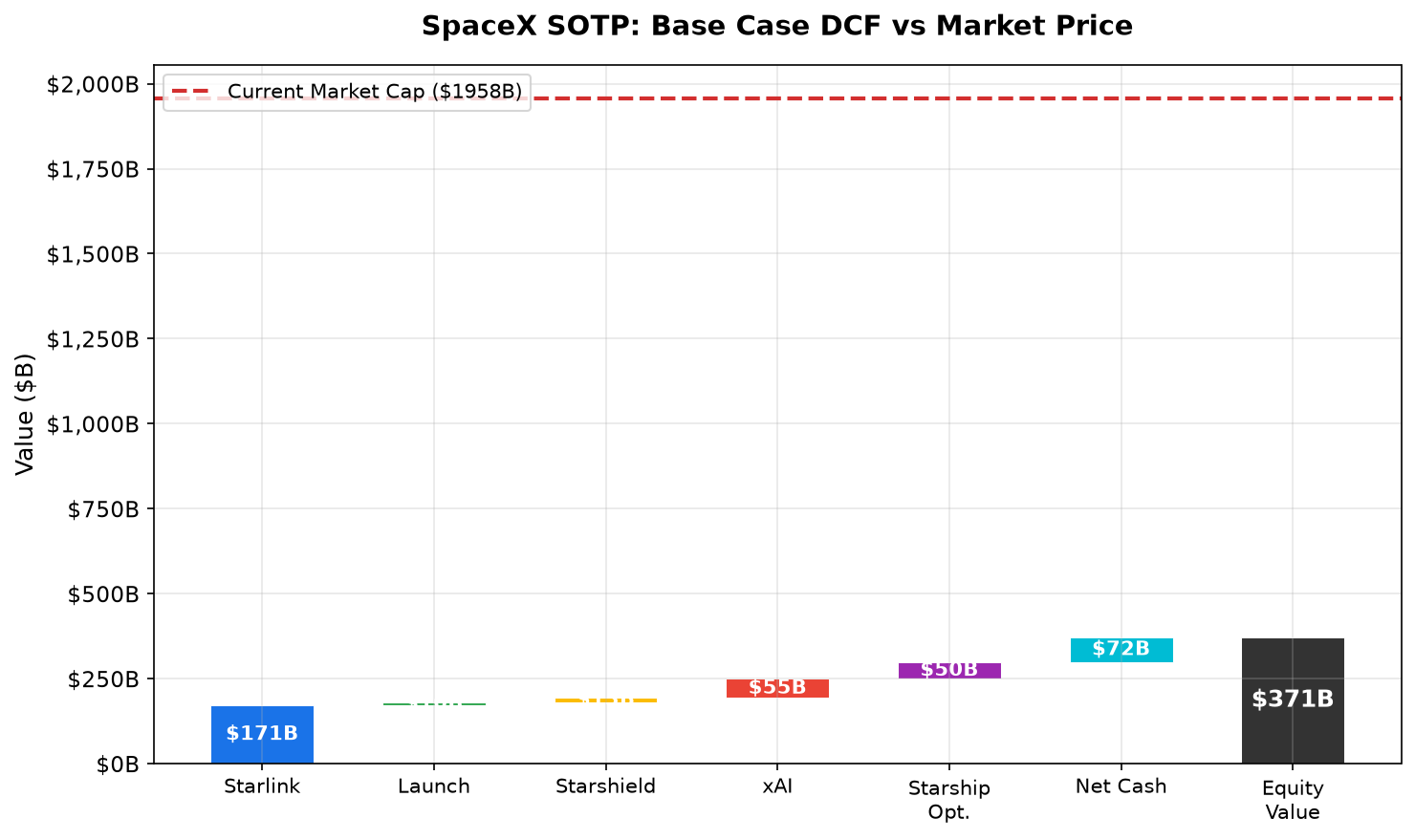
Our base case SOTP produces an enterprise value of $300 billion. Adding $71.7B in net cash (though we note that $85.7B of the $100.8B cash came from the IPO and is earmarked for capex and acquisitions — it is a war chest, not a surplus) yields an equity value of $371 billion. Divided by 13.05 billion shares:
Base case fair value: $28 per share.
| Scenario | Starlink | Launch | Starshield | xAI | Starship | Net Cash | Equity | $/share |
|---|---|---|---|---|---|---|---|---|
| Bear | $88B | $5B | $5B | $0¹ | $10B | $72B | $180B | $14 |
| Base | $171B | $10B | $13B | $55B | $50B | $72B | $371B | $28 |
| Bull | $263B | $21B | $24B | $242B | $150B | $72B | $772B | $59 |
¹ Bear-case xAI DCF produces negative enterprise value (cumulative cash burn exceeds future cash flow PV). Floored at $0 for a business with real assets.
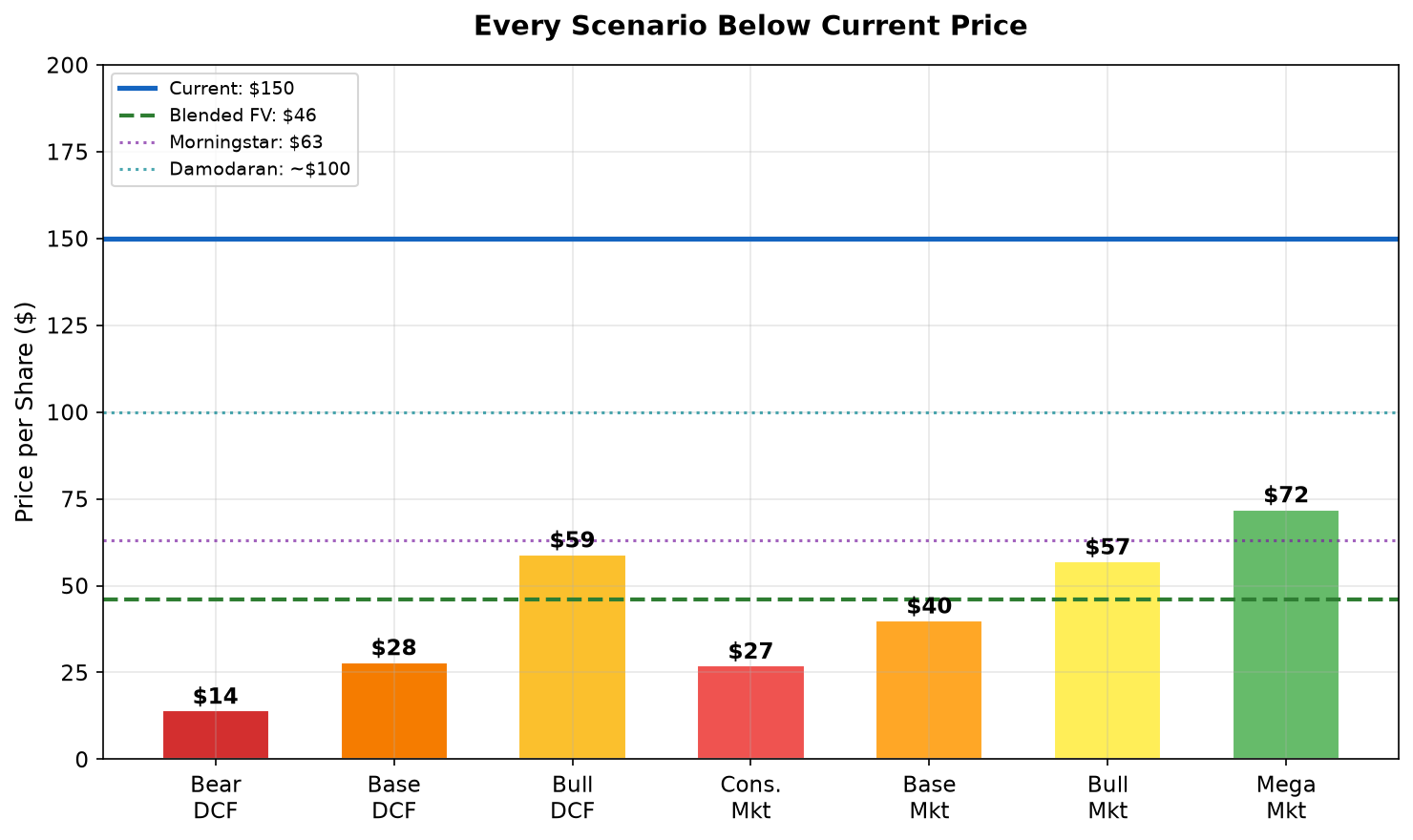
Even our bull case — which assumes Starlink reaches $92B in revenue, xAI captures $200B, Starship is worth $150B — produces $59 per share.
Market Approach: Peer Multiples
We cross-check the DCF with a multiples-based approach. Each segment is valued at segment-appropriate EV/Revenue multiples derived from comparable companies.
| Peer | Sub-Sector | EV/Revenue | Why Included |
|---|---|---|---|
| Iridium (IRDM) | Satellite comms | 8.0x | Closest pure-play satellite operator |
| Viasat (VSAT) | Satellite broadband | 3.3x | Direct satellite internet competitor |
| Lockheed (LMT) | Defense prime | 1.9x | Starshield margin benchmark |
| Northrop (NOC) | Defense/aerospace | 2.2x | National security space |
| NVIDIA (NVDA) | AI infrastructure | 19.3x | xAI compute infrastructure comp |
| Broadcom (AVGO) | AI infrastructure | 25.1x | Custom silicon + networking |
| Palantir (PLTR) | AI/defense tech | 59.2x | AI narrative premium comp |
Applying blended multiples to each segment (all using 2026E revenue bases):
| Scenario | Starlink (Rev/Multiple) | Launch | Starshield | xAI | Total EV | $/share |
|---|---|---|---|---|---|---|
| Conservative | $15.5B × 12 = $186B | $4.8B × 4 = $19B | $3.5B × 4 = $14B | $6.0B × 10 = $60B | $279B | $27 |
| Base | $15.5B × 18 = $279B | $4.8B × 6 = $29B | $3.5B × 6 = $21B | $6.0B × 20 = $120B | $449B | $40 |
| Bull | $15.5B × 25 = $388B | $4.8B × 10 = $48B | $3.5B × 8 = $28B | $6.0B × 35 = $210B | $674B | $57 |
| Mega-bull | $15.5B × 30 = $465B | $4.8B × 15 = $72B | $3.5B × 10 = $35B | $6.0B × 50 = $300B | $872B | $72 |
The market approach produces higher values than the DCF because multiples capture the market's current enthusiasm for AI and growth — enthusiasm that a discounted cash flow model, by construction, filters out. The 50% gap between DCF base ($300B EV) and market base ($449B EV) is itself informative: it quantifies the premium that momentum investors are paying over fundamental investors.
Even the mega-bull scenario — Palantir-like multiples on xAI, 30x on Starlink — produces $72/share, less than half the current price.
Blended Fair Value
Combining the income approach (DCF, 60% weight) and market approach (multiples, 40% weight), using the average of base and bull cases for each:
| Approach | Fair Value |
|---|---|
| DCF blend (base + bull average) | $44 |
| Market blend (base + bull average) | $49 |
| Blended fair value (60/40) | $46 |
We exclude the bear case from the blend because the bear case assumes contract failure and strategic missteps that, while possible, represent a tail risk rather than a central expectation. An equal-weighted three-scenario average (bear/base/bull) would produce approximately $40. We present both for transparency.
Our blended fair value: $46 per share. This is approximately 70% below the current price of $150, and below Morningstar's Sell-rated $63 target. It is also below Damodaran's $96-$103, reflecting our more conservative assumptions on xAI revenue durability and operating margins.
The Reverse DCF: What Does $150 Require?
Rather than asking what we think SpaceX is worth, let us ask what the market is pricing. At $150 per share, the implied enterprise value is $1.89 trillion. Starting from $18.7 billion in FY2025 revenue, what growth rate does the DCF require to produce that valuation?
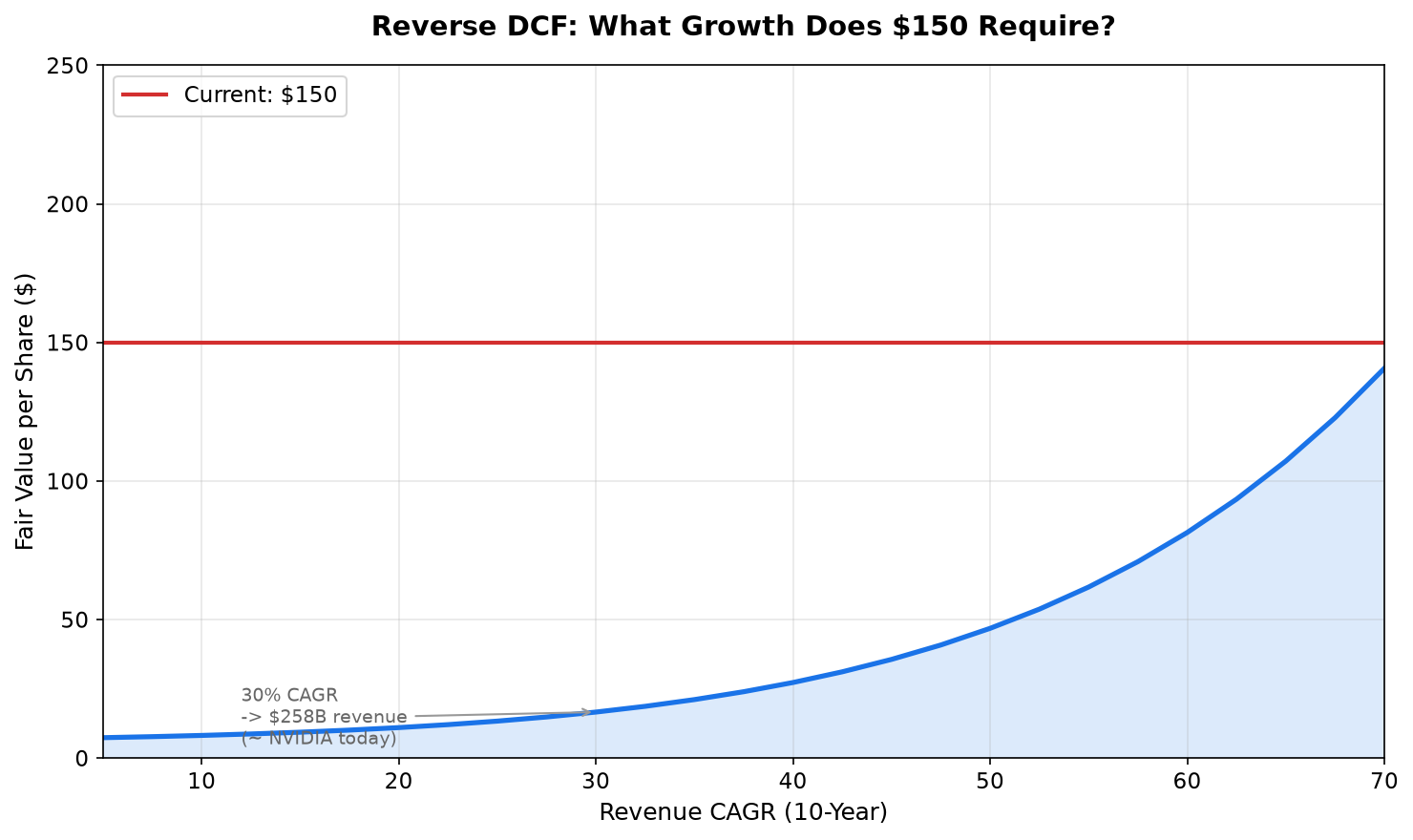
Even under the most generous assumptions we can construct — 20% operating margins, 8.5% cost of capital, capex declining to 8% of revenue — the reverse DCF requires a 54% compound annual growth rate for ten years. That would produce Year 10 revenue of $1.4 trillion.
At more moderate assumptions (12% operating margin, 9.5% cost of capital), the required growth rate is approximately 58%, implying Year 10 revenue of $1.8 trillion.
For context:
| Growth Rate | Year 10 Revenue | Comparison |
|---|---|---|
| 20% CAGR | $116B | Less than NVIDIA's FY2026 revenue ($253B) |
| 30% CAGR | $258B | Approximately NVIDIA today |
| 40% CAGR | $541B | Larger than Alphabet |
| 54% CAGR | $1.4T | Larger than Amazon (~$700B) and Apple (~$420B) combined |
The S-1 itself claims a total addressable market of $28 trillion — with $26 trillion attributed to AI. Damodaran called this estimate "bordering on fantasy," noting that it likely includes "all or most of the operating expenses of all businesses." Even accepting a generous $3-4 trillion AI TAM (Damodaran's revised estimate) plus a $200-500B space economy, the combined opportunity is perhaps $4-4.5 trillion. SpaceX capturing even 30% of that would require displacing every existing competitor across every adjacent industry.
The $150 price implies revenue growth that would make SpaceX larger than the two most valuable companies on Earth combined — within a decade.
The Analyst Spread
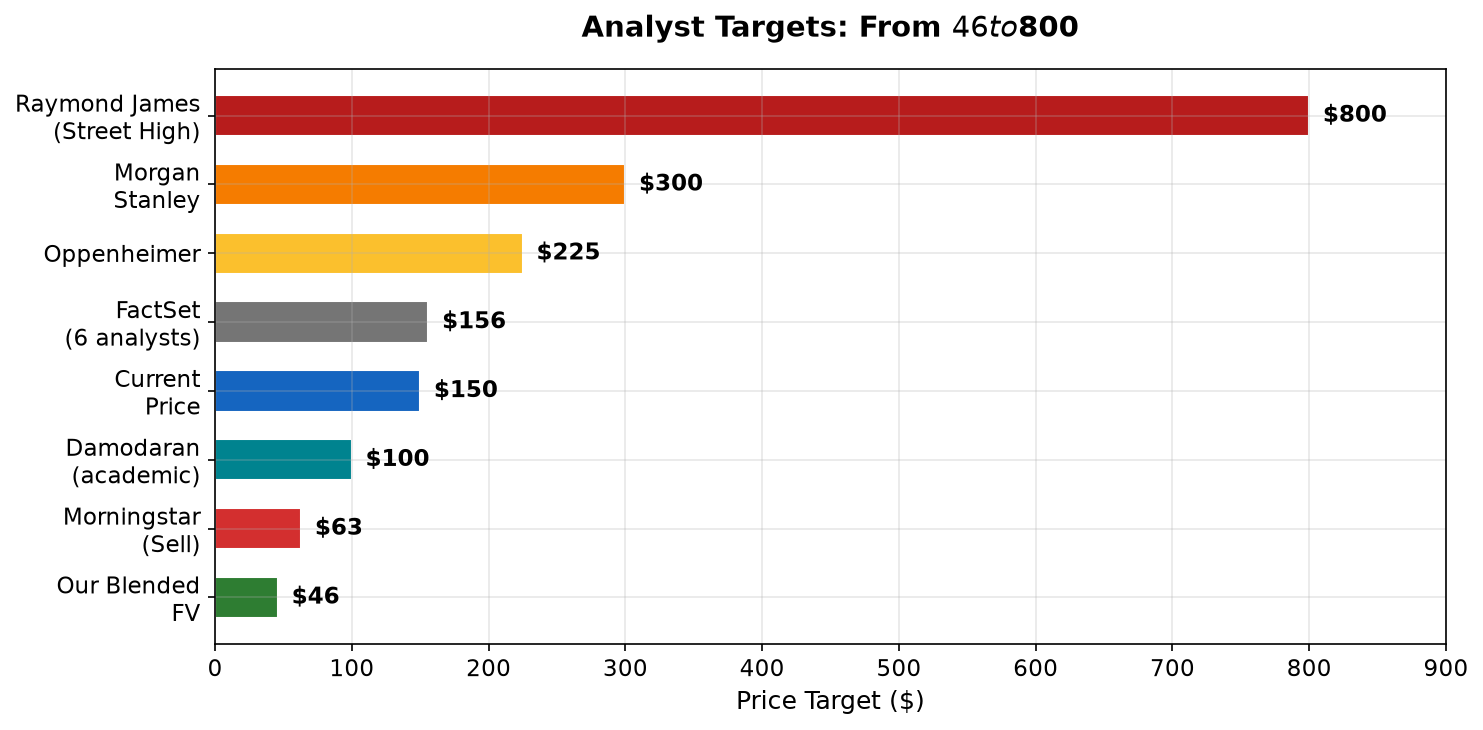
| Analyst | Rating | Target | Implied Market Cap | vs Current ($150) |
|---|---|---|---|---|
| Our blended fair value | — | $46 | ~$600B | -69% |
| Morningstar | Sell | $63 | ~$822B | -58% |
| Damodaran (academic) | — | ~$100 | ~$1.3T | -33% |
| FactSet consensus (6) | — | ~$156 | ~$2.04T | +4% |
| Oppenheimer | Overweight | $225 | ~$2.94T | +50% |
| Morgan Stanley | — | $300 | ~$3.92T | +100% |
| Raymond James | Strong Buy | $800 | ~$10.4T | +433% |
When analysts disagree by a factor of 13x on a $2 trillion company, the underlying business is not being valued on fundamentals. It is being valued on narratives about what Elon Musk might accomplish.
Raymond James's $800 target implies a $10.4 trillion market cap — approximately three times the value of Apple. To justify that, SpaceX would need to generate cash flows exceeding those of the entire technology sector combined. Brian Gesuale's thesis cites SpaceX as "the defining company of the era." That may prove correct. But "defining" is not the same as "worth $10 trillion."
Morgan Stanley's $300 target implies approximately $3.9 trillion. Even this requires xAI to become a dominant AI infrastructure provider generating hundreds of billions in annual revenue, Starlink to achieve global ISP scale, and Starship to transform launch economics — all simultaneously.
Morningstar's $63 Sell rating, dismissed as contrarian at $200, is the only sell-side target in the same range as our DCF output. Their core argument — that xAI's cash burn poses a "material threat" to the consolidated valuation, that governance risk under Musk's 85% voting control is extreme, and that SpaceX is "significantly overvalued" — is consistent with every model we can construct.
What Would Change Our Assessment
We are not claiming certainty. We are claiming that the burden of proof is on the bulls, and the numbers do not support them at current prices. Here is what would shift our model:
1. xAI contract durability. If the Anthropic contract ($15B/year) is renewed or extended beyond its initial term without cancellation, and the Google contract ramps as scheduled, xAI's revenue trajectory justifies a higher valuation. One quarter of clean contract revenue data would shift our model materially.
2. Starship commercial economics. If Starship achieves commercial payload delivery in H2 2026 and demonstrates sub-$100/kg to LEO, the launch segment DCF would need fundamental rebuilding. Our $50B optionality estimate could prove conservative.
3. Starlink ARPU stabilization. If ARPU stops compressing — if enterprise and government revenue growth offsets consumer declines — Starlink's margin trajectory improves.
4. First earnings report (August 2026). This is the binary catalyst. If Starlink revenue and margins scale faster than expected while xAI's operating loss narrows, the model needs upward revision. If xAI's burn accelerates or the Anthropic contract shows strain, the downside strengthens.
The Verdict
We asked in our first post whether $190 support would hold. It didn't. We tracked the correction to $155 and noted the analyst consensus had been vindicated. The stock is now at $150 — and our SOTP DCF, cross-checked with peer multiples and stress-tested through a reverse DCF, suggests fair value is approximately $46 per share.
The gap between $46 and $150 is not explained by any reasonable set of cash flow assumptions. It is explained by narrative, momentum, forced index buying, and a float so thin (5%) that price discovery is structurally impaired. The reverse DCF is unambiguous: $150 requires revenue growth that would make SpaceX larger than the two most valuable companies on Earth combined within a decade, across markets whose combined size is approximately $4-4.5 trillion even under generous assumptions.
SpaceX contains a genuinely exceptional business (Starlink) inside a capital-intensive launch monopoly inside a speculative AI venture. The market is pricing the whole package as if all segments will achieve maximum potential simultaneously. Our bull case, which does exactly that, still only reaches $59.
The first earnings report in August is when the narratives meet the numbers. Until then, every position in SPCX — long or short — is a bet on whether Elon Musk's track record of defying conventional valuation constraints extends to a company whose price implies physics-defying growth. The arithmetic, at least, is not on his side.
This analysis is for informational purposes only and does not constitute investment advice. SpaceX (SPCX) is an extremely volatile newly public stock with a 5% free float. All readers should conduct their own due diligence and consult with a licensed financial advisor. Our DCF model assumptions are stated in full above — every input is disclosed. The model is published, not "available on request." We acknowledge that our assumptions are conservative and that reasonable analysts (including Damodaran) reach higher valuations with different inputs. The disagreement is in the assumptions, not the methodology.